Combining different movement methods can be useful, but a crowded schedule does not automatically create balanced training. The appeal of yogalates singapore is that yoga-inspired range and Pilates-style precision can be explored within one integrated session. The challenge is deciding how that session fits alongside strength work, running and other weekly activities.
A successful combination does not attempt to maximise flexibility and muscular fatigue at the same time. It uses range, control and recovery according to the participant’s wider training priorities.
Range and Precision Answer Different Questions
Yoga-influenced movements may explore standing positions, folds, rotations and extended ranges. These movements can help participants notice where mobility is available and where it feels restricted.
Pilates-inspired exercises often ask how well the trunk and joints can control movement. The leg may move only through a moderate range while the pelvis remains steady. The exercise can feel demanding even though the final shape is not dramatic.
Together, these approaches ask two related questions:
- What range can the participant access?
- How much of that range can the participant manage?
A useful Yogalates session moves between these questions rather than assuming that more range or more tension is always better.
Do Not Treat Yoga and Pilates as Opposites
Yoga is not only stretching, and Pilates is not only abdominal work. Both methods can involve strength, mobility, balance, breathing and coordination.
The practical difference in a combined class often lies in emphasis. A yoga-based position may establish a broader movement shape, while a Pilates-style variation narrows attention to a particular control challenge.
For example, a standing lunge may explore hip and ankle range. A subsequent floor exercise may ask the participant to move one leg without allowing the pelvis to rotate. The two exercises approach hip function from different directions.
This pairing becomes useful when the instructor connects the purpose clearly.
Build the Week Around Priority Sessions
Yogalates should not be added to every available gap without considering fatigue. Slow, controlled work can challenge the trunk, hips and shoulders even when the class does not feel highly cardiovascular.
If strength training is the main priority, place Yogalates where it will not reduce performance in key lifting sessions. If running performance matters most, avoid creating substantial leg fatigue immediately before intervals or a long run.
A possible week could include:
- Monday: Strength training.
- Tuesday: Easy cardiovascular work.
- Wednesday: Yogalates.
- Thursday: Rest or walking.
- Friday: Strength training.
- Saturday: Longer run or recreational sport.
- Sunday: Recovery according to fatigue.
Someone training fewer days could replace a separate mobility session with Yogalates rather than adding another commitment.
Match the Class Effort to the Week
The same exercise can produce different training demands depending on range, tempo and support.
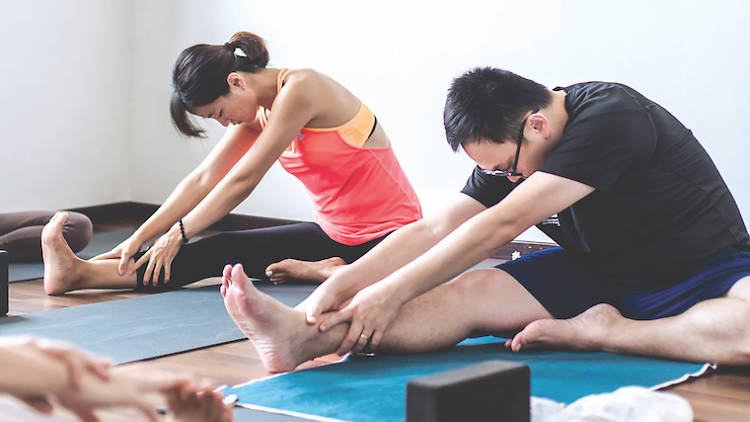
A standing pose held briefly with a smaller range may support movement practice. The same pose held deeply for an extended period can create substantial leg fatigue.
Pilates-style trunk work can also be adjusted through lever length and repetition count. Moving one bent leg is usually less demanding than lowering two straight legs while maintaining the same trunk position.
Participants can manage intensity by:
- Reducing range.
- Shortening holds.
- Using additional support.
- Keeping the knees bent.
- Selecting fewer repetitions.
- Resting before technique deteriorates.
- Avoiding competition with nearby participants.
These adjustments help the class complement the week rather than compete with it.
Use Yoga Range to Inform Control Work
A participant may notice during a yoga-based pose that one hip rotates more easily than the other. The Pilates portion can then explore whether the pelvis remains stable when each leg moves independently.
Similarly, an overhead pose may reveal that one shoulder has less comfortable range. A controlled arm exercise can examine whether the participant compensates through the ribs or neck.
This creates a feedback loop. Range exposes the available movement, and precision work examines how that movement is organised.
The session becomes more than a collection of unrelated exercises when participants understand this relationship.
Use Control Work to Refine Range
Precision can also improve how a participant approaches yoga positions. After practising trunk control, someone may enter a forward fold without collapsing quickly into the deepest available range.
Following controlled hip work, a standing balance may feel more stable even if the leg is not lifted as high.
The goal is not to make every yoga pose rigid. It is to provide enough muscular organisation that range can be explored intentionally.
Avoid Redundant Training
Mixed-method training can become repetitive when the same tissues are loaded in similar ways across multiple sessions. A person may perform planks in strength training, fitness classes and Yogalates without recognising the accumulated shoulder and trunk load.
Review the week according to movement demands rather than activity names. Count how often the programme includes:
- Extended arm support.
- High-volume abdominal work.
- Deep lunges.
- Long hamstring stretches.
- Single-leg balance.
- Intense shoulder loading.
If the same demand appears repeatedly, modify one session instead of assuming that different class names provide different recovery effects.
Monitor Useful Outcomes
Progress in Yogalates does not need to be measured by calorie expenditure or maximum pose depth.
Better indicators include:
- Smoother transitions.
- Improved control near the end of a set.
- Ability to breathe during challenging positions.
- Reduced left-to-right inconsistency.
- Less unnecessary tension.
- Greater confidence modifying an exercise.
- Stable energy for the next training day.
The wider programme is working when the participant can practise consistently without accumulating avoidable fatigue.
Create an Integrated Training Role
At Yoga Edition, participants can use Yogalates as a combined movement session rather than trying to fit separate yoga and Pilates classes into an already crowded week. Telling the instructor about other training can help determine when a smaller range or lower-intensity variation is appropriate.
Yoga-inspired range and Pilates precision work best when they inform each other. Range without control may be difficult to use, while precision without varied movement can become narrow.
An effective training week gives each activity a defined role. Yogalates can occupy the space between mobility exploration and controlled strength, provided its intensity is planned honestly. That balance allows the session to add useful movement variety without quietly becoming another source of fatigue.